Types of orthodontic pliers
Wire bending and loop forming pliers
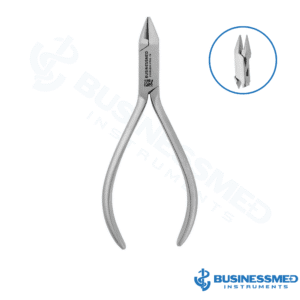
The beak decides the bend: grooved (101, Jarabak), round cones (107), conical and pyramidal (139 bird beak, with long, lap-joint and carbide-cutter versions), concave-convex (optical pliers), flat parallel (Adams, for the Adams clasp of removable appliances), stepped (Nance with four steps and a loop-closing groove; step pliers for bayonet bends), sectioned round (Tweed, for bull and helical loops) and the long tapered light wire plier. Lingual arch forming pliers make double-back and triple-back bends.
Archwire placement and adjustment
Pliers that work on the archwire in the mouth: the How plier, straight or curved, with long tapered beaks and serrated tips for placing and removing archwires and pins; the lip-safe Weingart; cinch back pliers that bend the wire end behind the molar tube; V-stop pliers that press a stop into the wire; and inner and outer torquing pliers used together on rectangular wire.
Contouring and crimping pliers
For crowns, bands and attachments: Johnson contouring pliers with a convex tip against a concave tip, Goslee, Gordon, Peeso and the three-in-one Triplex; crown and band crimping pliers that turn the gingival margin inward; hook crimping and tube crimping pliers; and De La Rosa and hollow chop pliers that contour archwire without twisting it.
Band and adhesive removing pliers
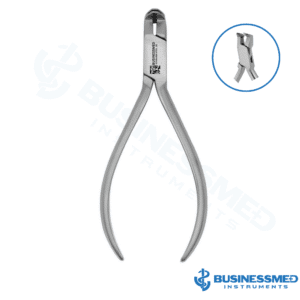
A beveled beak hooks under the band edge while a replaceable pad rests on the tooth: posterior band removing pliers in short and long versions and an anterior pattern; the adhesive removing plier clears composite left after debonding.
Ligature, separator and utility pliers
Coon ligature tying pliers and Steiner tying pliers for steel ligatures; reverse-action force module separating pliers that stretch elastic separators; and lab and office pliers — 121, 122, flat nose, McKellop clasp and the universal crampon.
How to choose pliers — orthodontics by job
- Start from the job. Bending and loops → wire bending pliers; placing or finishing the wire in the mouth → How, Weingart, cinch back, V-stop, torquing; crowns and bands → contouring and crimping; removal → band and adhesive removers; ties and separators → ligature and separating pliers.
- Beak shape. It sets the bend: round for curves, flat for square bends, stepped for repeatable loop sizes, concave-convex for smooth loops.
- Wire weight. The light wire plier has a long tapered bird beak for light wire; the #100 lingual bar plier has heavy rounded beaks.
- Tungsten carbide tips. TC versions of the How and bird beak carry carbide gripping or cutting inserts.
- Chair or laboratory. How and Weingart tips are lip safe for intraoral work; the 121 and 122 are lab and office pliers.
What are orthodontic pliers used for?
Making and adjusting fixed and removable appliances: forming loops, springs, clasps and arches; placing, bending, cinching and torquing archwires; tying ligatures and placing separators; contouring and crimping crowns, bands, hooks and space maintainer tubes; and removing bands and adhesive at the end of treatment. Ortho pliers and dental pliers of this kind work at the chair and on the laboratory bench.
How BusinessMed orthodontic pliers are made
German stainless steel with a satin, non-reflective finish; tungsten carbide inserts on the TC patterns. Reusable, autoclavable and covered by a 5-year warranty.