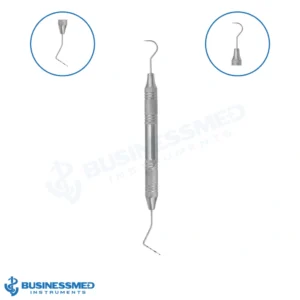
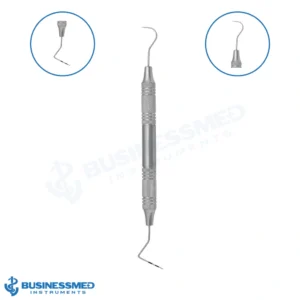
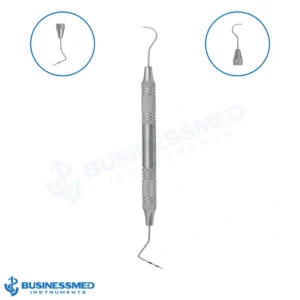
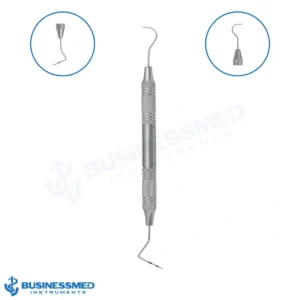
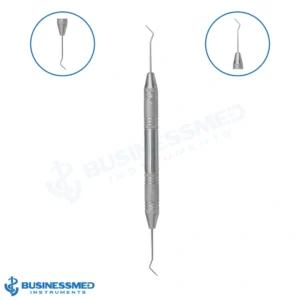
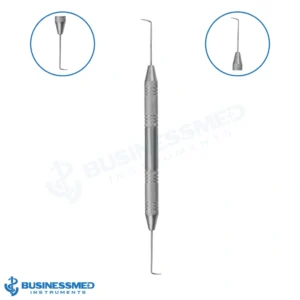
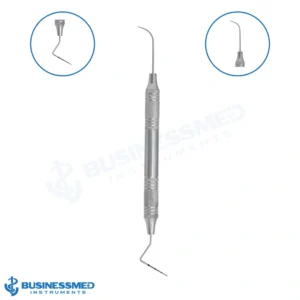
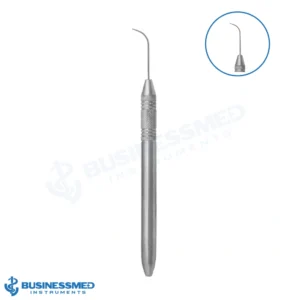
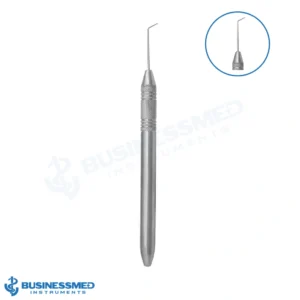
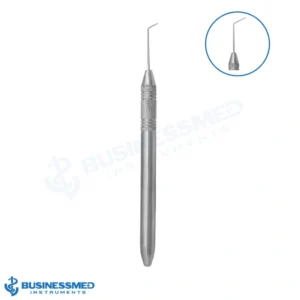
Types of dental explorers
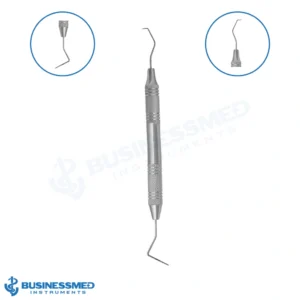
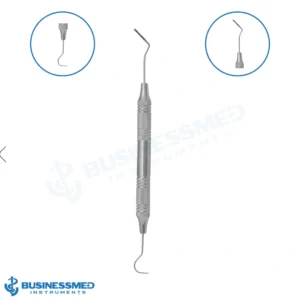
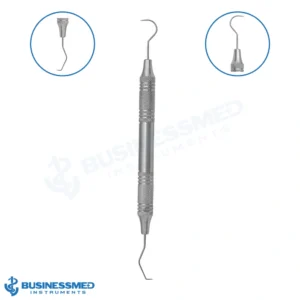
Shepherd's hook #23 and #17
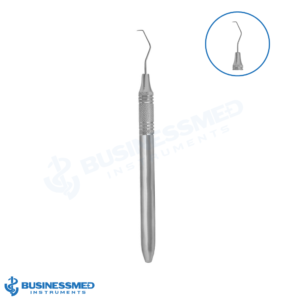
The #23 shepherd's hook is the most common dental explorer — the explorer dentists and hygienists use for general caries and calculus detection. The #17 has a short angled point for interproximal areas; the #5 explorer combines the two shapes, and the #17 single-ended explorer comes on a slim handle.
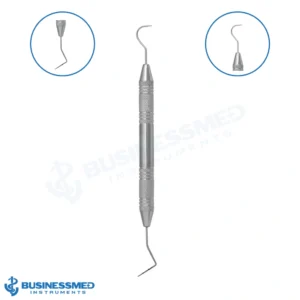
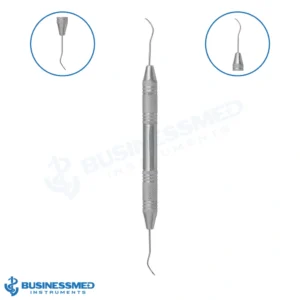
Pigtail and cowhorn explorers
Paired curved tips reach proximal surfaces from both sides: the #2A contra-angled pigtail, the #2 and #2H, and the curved #3 cowhorn-type explorer with its 3A and right-angle 3ES variants.
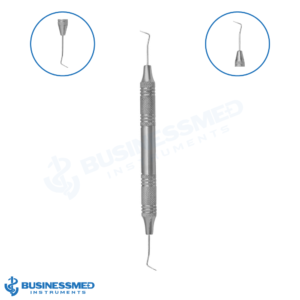
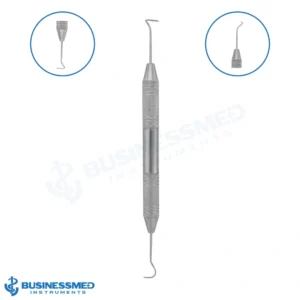
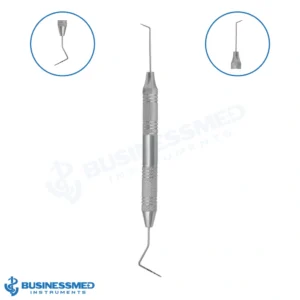
#6 explorers
A straight fine point on a near right-angle bend, with the tip length counted from the bend: the standard #6 and the long-tip 6XL explorer.
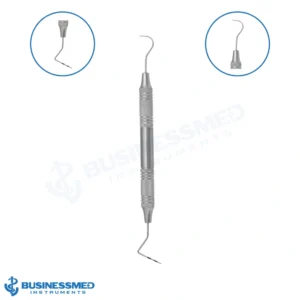
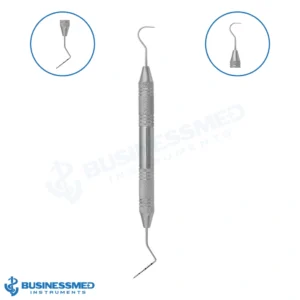
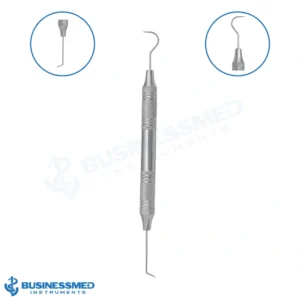
Expros (explorer and probe)
An expro carries a #23, #17, #6 or 3A explorer on one end and a periodontal probe on the other — Williams, the WHO ball-end CP11.5B, CP8, CP12, CP18, UNC12, UNC15 or the flat Goldman-Fox. Examples: the #23 explorer and UNC15 probe, the #23 explorer and CP11.5B probe and the #17 explorer and Williams probe.
How to choose a dental explorer
- Tip shape by surface. #23 for general detection, #17 and the pigtails for proximal surfaces, the cowhorn curves for interproximal, furcation and subgingival areas, #6 for a straight reach.
- Single or double-ended. Double-ended explorers sit on the H4 hollow handle; single-ended ones on the H5.
- Expro probe scale. Pick the probe end that matches the markings the practice charts with: Williams 1-2-3-5-7-8-9-10, CP patterns marked at set depths (CP12 at 3-6-9-12), UNC every millimeter. Single probes are in Periodontal Probes.
- Explorer or endodontic explorer. Long, slim endodontic explorers for locating canal orifices are in Endodontic Explorers.
What are dental explorers used for?
An explorer dental instrument locates carious lesions, decalcified areas, calculus, surface irregularities and defective restoration margins, and explores periodontal pockets and furcations. Expros add pocket-depth readings to the same pass.
How BusinessMed dental explorers are made
German stainless steel with a satin, non-reflective finish on hollow handles; reusable, autoclavable and covered by a 5-year warranty.